Purchase Order Approval Process: The $506 Per PO Cost Breakdown
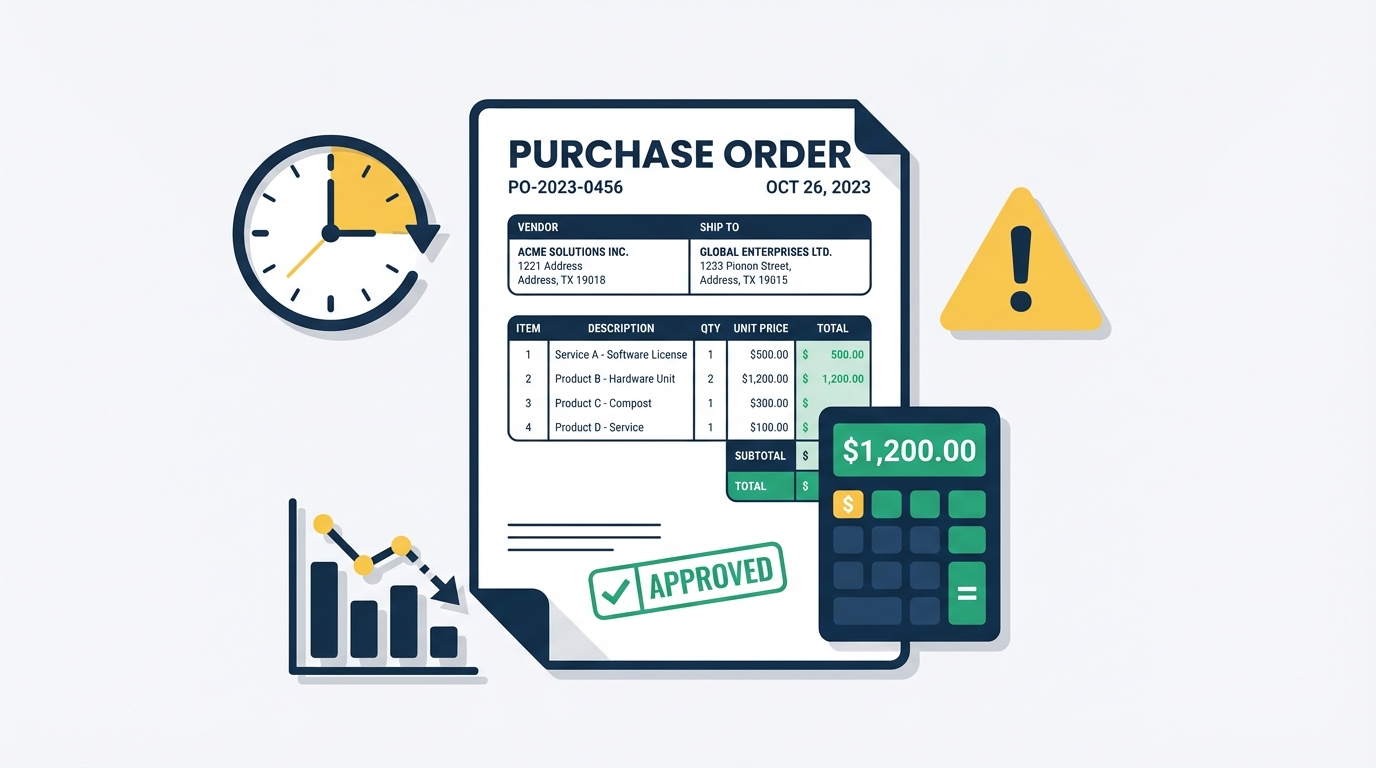
That $15,000 purchase order sitting in someone's inbox isn't just waiting for approval. It's hemorrhaging money every hour it sits there—money most companies never realize they're losing.
Most finance teams track the obvious costs: the software license, the equipment rental, the consulting fee. But the purchase order approval process that moves those requests from "submitted" to "approved"? That's where the real money disappears.
What Actually Goes Into Processing a Purchase Order?
Before we break down the $506 figure, let's map out what a typical purchase order approval workflow actually involves. Understanding each step reveals where costs accumulate.
The Standard Purchase Order Approval Process Flowchart
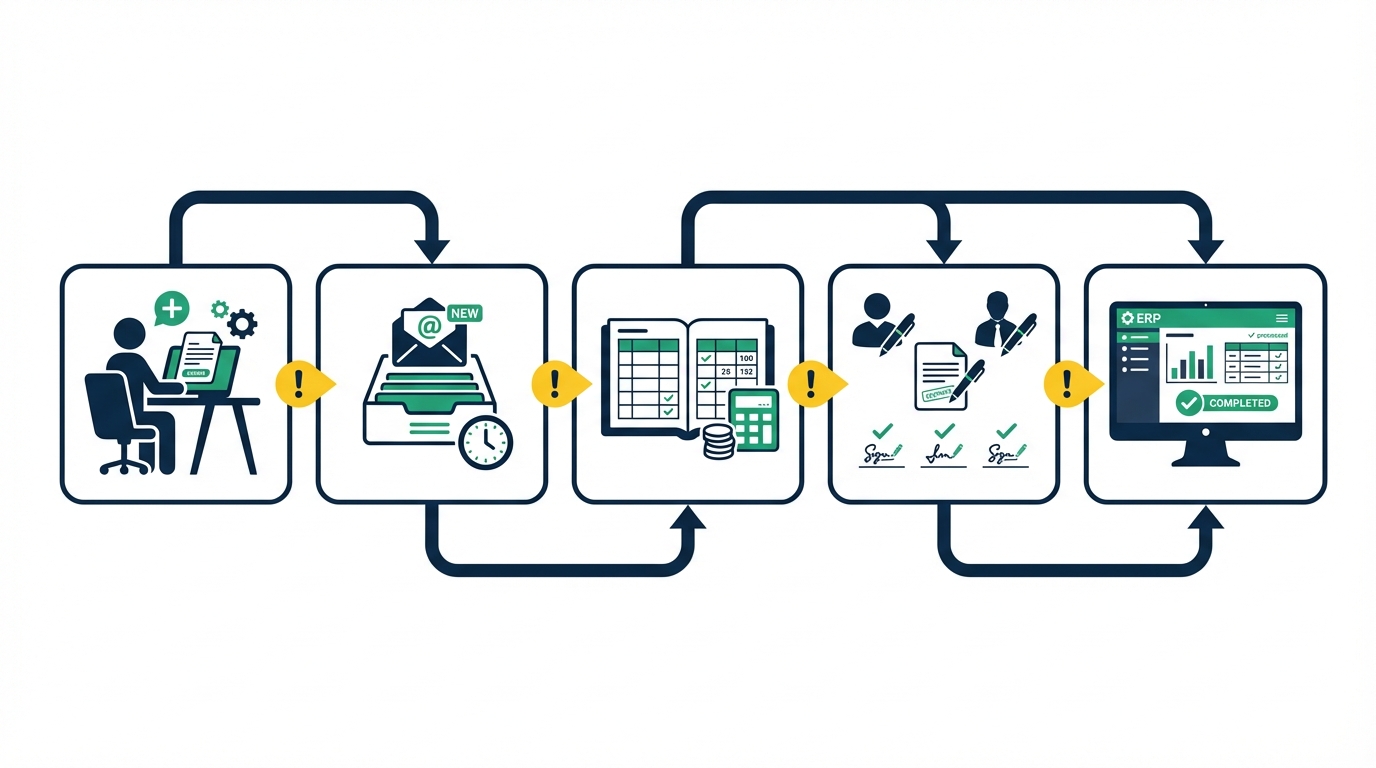
A typical purchase order moves through multiple stages, each with its own labor and time requirements:
- Request initiation: Someone identifies a need and creates a purchase request
- Documentation gathering: Specs, quotes, and vendor information get compiled
- Budget verification: Finance confirms funds are available
- Routing to approvers: The request moves to the right decision-maker(s)
- Review and approval: Approvers evaluate and approve, reject, or request changes
- PO generation: Approved requests become official purchase orders
- Vendor transmission: The PO gets sent to the supplier
- Documentation and filing: Everything gets logged for audit trails
Each step involves labor, waiting time, and potential for errors that create rework. In manual systems—email threads, spreadsheets, paper forms—these steps multiply in cost.
The $506 Breakdown: Where Every Dollar Goes
The $506 per PO figure comes from CAPS Research benchmarking data, which analyzes procurement costs across industries. Here's how that breaks down:
Direct Labor Costs: $180-$220
This covers the actual time humans spend touching the purchase order:
- Requester time (15-30 minutes): Creating the initial request, gathering quotes, filling out forms
- Approval review time (10-20 minutes per approver): Reading documentation, verifying details, making decisions
- Administrative processing (20-40 minutes): Data entry, filing, sending communications, following up
- Finance verification (10-15 minutes): Budget checks, coding, system entry
At an average fully-loaded labor cost of $45-60/hour for the roles involved, these minutes add up fast.
Delay Costs: $150-$200
This is where manual purchase order approval processes bleed money invisibly. According to a 2024 State of Procurement Survey, over 56% of procurement teams struggle with slow approvals and manual workflows.
- Rush shipping premiums: When approvals take too long, you pay extra to meet deadlines
- Missed early-payment discounts: Net-10 2% discounts vanish when approvals drag
- Project delays: Teams waiting on approved purchases can't move forward
- Expediting fees: Vendors charge more when you need things faster due to internal delays
The average PO sits in approval limbo for 5-7 business days in manual systems. Each day of delay has a compounding cost.
Error and Rework Costs: $80-$120
Manual processes invite mistakes, and mistakes cost money to fix:
- Wrong approver routing: Requests go to the wrong person, requiring restart
- Missing information: Incomplete requests bounce back for revision
- Version confusion: Multiple email threads create conflicting approvals
- Data entry errors: Manual transcription between systems introduces mistakes
Studies show 15-20% of manually processed POs require some form of rework—essentially doubling the labor cost for those orders.
Compliance and Audit Trail Costs: $40-$60
Maintaining proper documentation for audits isn't free:
- Documentation assembly: Creating paper trails for compliance after the fact
- Audit preparation: Gathering approval evidence when auditors ask
- Exception handling: Explaining gaps or inconsistencies in approval records
- Remediation: Fixing compliance issues discovered in audits
Companies using email-based approvals spend significantly more time reconstructing approval histories because evidence is scattered across inboxes.
The Hidden Multiplier: Approval Routing Complexity
The $506 average assumes a relatively simple approval chain. But most organizations have multi-step approvals with conditional routing based on:
- Dollar thresholds: Different approval levels for $1K vs $10K vs $100K purchases
- Department budgets: Cost center managers must approve their team's spending
- Vendor requirements: New vendors might need additional sign-off
- Category rules: IT purchases vs office supplies vs professional services
Each additional approval layer adds $50-$100 to the processing cost. A four-level approval chain can push costs well beyond $700 per PO.
Purchase Order Approval Email: The Silent Budget Killer
Let's talk about how most SMBs actually handle purchase approvals: email.
The typical purchase approval request via email looks something like this:
Subject: Approval Needed - Software License $4,500
Hi [Manager],
Can you approve this purchase? Quote attached.
Thanks,
[Requester]
This kicks off a chain of problems that email workflows simply aren't designed to solve:
Problem #1: No Visibility
Once that email sends, the requester has no idea where it stands. Is the manager on vacation? Did it go to spam? Is it sitting in a folder marked "deal with later"? Nobody knows until someone asks—which means someone has to follow up.
Problem #2: No Accountability
Email timestamps show when messages were sent, not when they were read or acted upon. There's no audit trail of the actual decision—just a reply somewhere in a thread that might say "approved" or "looks good."
Problem #3: No Escalation
When an approval sits untouched for three days, nothing happens automatically. The system doesn't know to notify anyone. Escalation requires a human to notice the delay and manually intervene.
Problem #4: No Integration
That "approved" reply doesn't automatically update your accounting system, trigger the PO generation, or notify the vendor. Every downstream action requires manual intervention.
Real Cost Example: A $4,500 Software Purchase
Let's trace an actual purchase order through a typical manual approval workflow to see where the $506 manifests.
Day 1 - Request Initiation (45 minutes)
- Operations manager identifies need for project management software
- Researches options, gets three quotes
- Fills out internal purchase request form
- Sends email to finance for budget verification
Day 2 - Budget Check (30 minutes)
- Finance analyst receives request
- Looks up budget codes and available funds
- Confirms budget availability via email reply
- Forwards to department head for approval
Days 3-5 - First Approval Limbo
- Department head is in meetings
- Email sits in inbox
- Requester follows up on Day 4
- Department head approves on Day 5, forwards to VP (purchase over $2,500 threshold)
Days 6-8 - Second Approval Limbo
- VP traveling
- Email marked for later
- Department head follows up on Day 7
- VP approves on Day 8 via mobile email: "Fine with me"
Day 9 - Processing (40 minutes)
- Admin receives forwarded approval chain
- Enters data into accounting system
- Generates PO number
- Sends to vendor
- Files email chain for records
Total elapsed time: 9 business days
Total labor time: ~3 hours across 5 people
Hidden cost: Vendor's 10% early-payment discount expired on Day 5
For a $4,500 purchase, that's $450 in lost discount alone—nearly matching the processing cost itself.
Why Manual Approval Costs Scale Exponentially
Here's the part that keeps finance controllers up at night: manual approval costs don't scale linearly. They compound.
A company processing 50 POs per month faces:
- $25,300 in direct processing costs annually
- Manageable follow-up burden
- Reasonable audit preparation
Scale to 200 POs per month:
- $101,200 in direct processing costs annually
- Multiple FTEs dedicated to purchase administration
- Exponentially more "where's my approval?" interruptions
- Audit preparation becomes a quarterly project
The problem isn't just 4x the volume—it's 4x the complexity, 4x the follow-up burden, and 4x the opportunities for things to fall through cracks.
The Audit Trail Reality Check
Beyond daily processing costs, there's a compliance time bomb ticking in email-based approval systems.
When auditors ask "who approved this purchase and when?", companies using email approvals face:
- Search time: Digging through email archives across multiple accounts
- Reconstruction: Piecing together approval chains from forwarded messages
- Gaps: Finding approvals that happened verbally or via text with no documentation
- Inconsistency: Different approvers using different response formats
One mid-size manufacturing company reported spending 80+ hours preparing for their annual procurement audit—essentially reconstructing approval evidence that a proper system would generate automatically.
What Good Looks Like: Modern PO Approval Meaning
A modern purchase order approval process maintains the same controls and approvals while eliminating the waste:
- Single submission point: Requesters enter data once, in a structured format
- Automatic routing: Rules direct requests to the right approvers based on amount, category, and department
- One-click approval: Approvers decide from email, Slack, or mobile with a single tap
- Real-time visibility: Everyone sees exactly where requests stand
- Automatic escalation: Overdue approvals trigger reminders and escalations
- Built-in audit trail: Every action logged with timestamps and user attribution
This doesn't require enterprise software or IT projects. Modern workflow tools can implement this in days, not months.
Calculating Your Organization's PO Cost
The $506 figure is an average. Your actual cost depends on your specific process. Here's a quick calculation framework:
Step 1: Map your approval chain
- How many people touch a typical PO?
- What are their fully-loaded hourly rates?
- How many minutes does each person spend?
Step 2: Measure your cycle time
- Average days from request to approved PO
- Percentage requiring follow-up
- Percentage requiring rework
Step 3: Quantify delay impacts
- Rush shipping premiums paid last quarter
- Early-payment discounts missed
- Project delays attributed to procurement
Step 4: Add compliance overhead
- Hours spent on audit preparation
- Time reconstructing approval documentation
- Cost of compliance exceptions or findings
Most organizations that do this exercise find their actual cost exceeds the $506 benchmark—often significantly.
Moving From Cost Center to Efficiency Driver
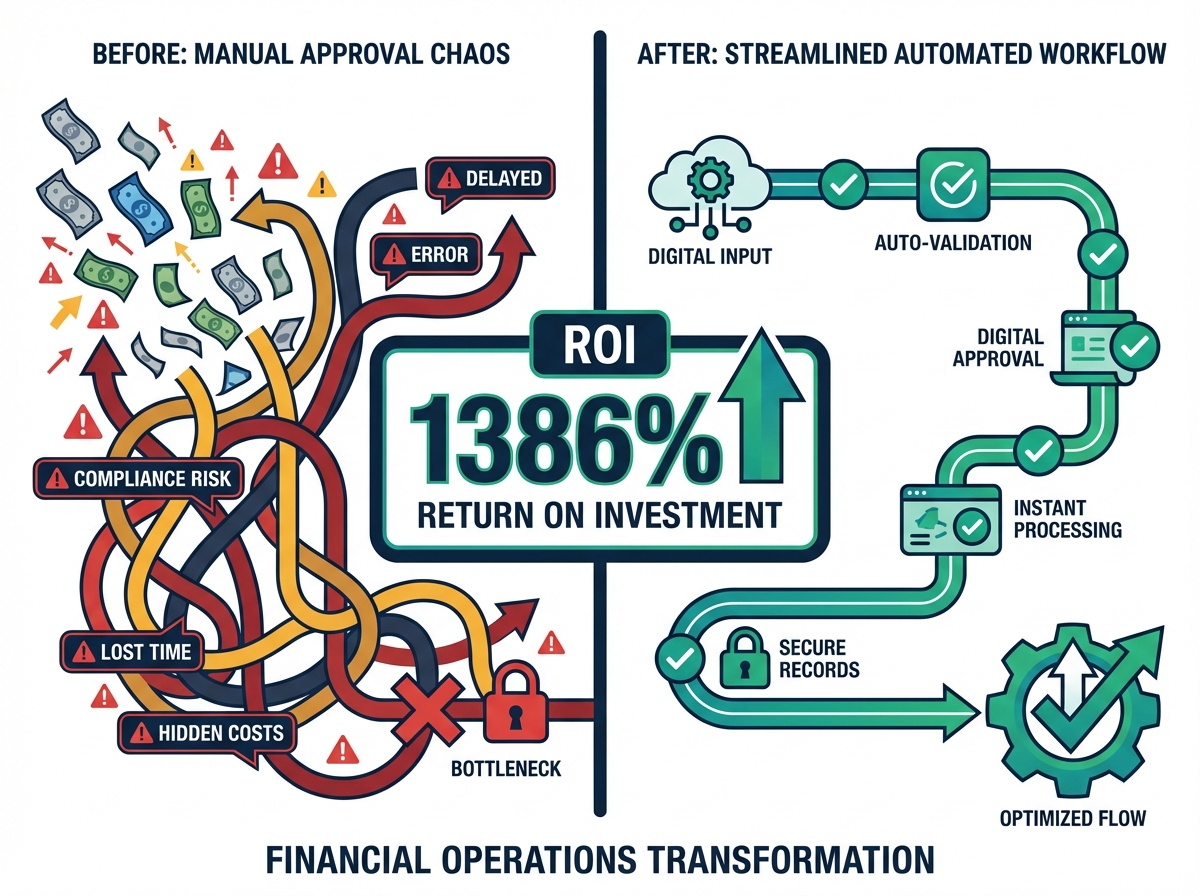
The purchase order approval process doesn't have to be a $506-per-transaction tax on your operations. The same approvals, the same controls, the same compliance—delivered through a modern workflow—typically costs under $50 per PO in total processing overhead.
That's not about removing approvals or cutting corners. It's about removing the waste around the approvals: the waiting, the following up, the re-entering data, the searching for documentation.
For a company processing 100 POs per month, the difference between $506 and $50 per PO represents over $54,000 annually. That's not theoretical savings—it's labor hours redirected to actual work, missed discounts captured, and audit prep that takes hours instead of days.
The question isn't whether your manual approval process is costing you money. It's how much—and what you could do with those resources if they weren't tied up in administrative overhead.